While digital transformation has recently become a key priority for the financial services sector, last year was a landmark period in this journey. Nearly half (49%) of firms have accelerated their initiatives, finds Deloitte, and the financial services sector has far outpaced other industries in their digital investments (arguably, because our industry was so far behind others).
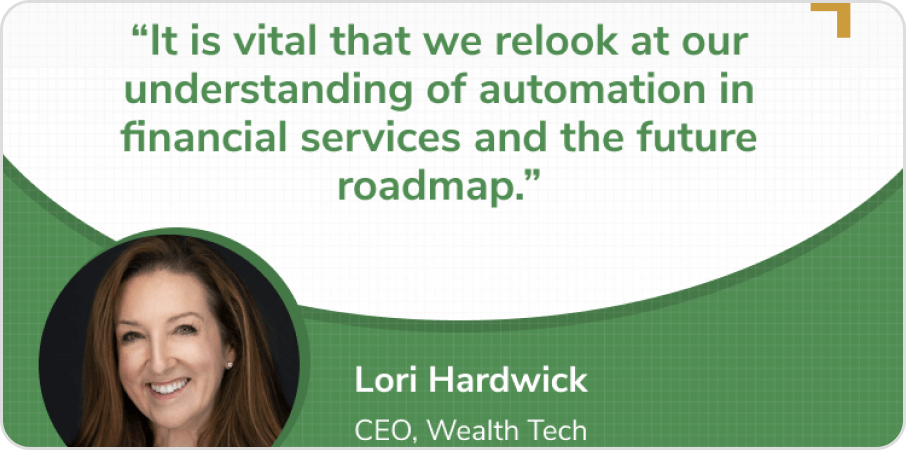
Over the years I’ve been part of several C-suite management teams and corporate boards for leading organizations at the intersection of financial services and tech. One first-hand observation I have made is that automation not only achieves short-term benefits like headcount of expense reduction, but it also creates a ripple effect that permeates across the entire company’s ecosystem. Strategic automation at the backend allows advisors to be more efficient in their work, and in turn, drives a far superior experience for the end customer. To achieve such holistic impacts, it is vital that we relook at our understanding of automation in financial services and the future roadmap.
Financial Services institutions have been primarily focused on building out an integrated infrastructure with interoperability between systems that enable a unified rendering of data for advisors. But this is only step one: It is when effective automation of front, mid, and back-office processes meets 360-degree business objectives, only then, advisors are free to build more capacity in their day and devote their time to more meaningful work, and eventually drive long-term business growth through lasting relationships with customers.
Unlock the potential of AI-powered transformation. Talk to one of our experts today.
2020 was a landmark year for digital transformation. In the face of an unprecedented global crisis, technology emerged as the key enabler for resilience for all types of businesses —small teams or multinational enterprises, consumer-oriented or B2B vendors alike. Now, as we work through the road to recovery, many face the slightly uncomfortable question: How much of this change is scalable and operationally sustainable for the long term, including in terms of ROI?
The question becomes more pertinent as we look at these facts from McKinsey & Company’s recent report on the sheer pace of digital transformation last year:
The digitalization of customer interactions accelerated by 3 years globally.
Companies started to digitally reimagine their products/services 7 years ahead of schedule.
Over 6 in 10 executives believe customer expectations have changed forever.
Yet, most companies are not positioned to sustain their digital transformation projects for the long haul. Only half of them believe that the rapid surge in adoption of technology for their operations will continue after the pandemic – which could potentially stall progress or set the other half back by several years and tens of thousands of dollars of hurried sunk costs. Of course, there is always this risk when the shift is due to a black-swan moment and not organic, evolutionary change.
Moving beyond the pandemic, organizations will have to take hard-won learnings about the need for flexibility and responsiveness of AI digital transformation initiatives and determine ways to build real and lasting resilience that can ensure growth and the capability to weather future storms. A prime example of this is the accelerating trend of using intelligent automation digital transformation roadmaps, and automating more complex end-to-end business processes in a scalable, more sustainable way.
How the Pandemic Revealed Crucial Gaps in Digital Transformation plans
Many businesses learned vital lessons through the last year — involving crucial gaps that otherwise would have gone unnoticed — when they tried to push the pedal to the metal on their digital transformation plans.
Technology sprawl: In a bid to speed up digital adoption, business units and individual users were ready to adopt their favorite applications and enablers ‘under the radar’. This contributed to the ever-sprawling shadow IT landscape without organizational visibility, coordination or leverage. Only an integrated enterprise automation solution can put the power of technology enablement back in the hands of business users while keeping it within the realm of the organization’s overarching digital transformation framework and technology strategy.
Higher propensity for technical debt: If shadow IT was one side of the coin, the other was retro-fitted automation often requiring many code changes that aren’t always reconciled. In the pre-pandemic world, organizations were already struggling with technical debt as a multitude of non-integrated automation technologies were applied to legacy systems. In the emerging normal, they will look for ways to implement technology capabilities faster, without dramatic overhauls and inflexibility that results in technical debt. Adopting a HyperApps approach is a more viable way to achieve scalable, sustainable automation.
Culture woes: Cultural dissonance blocks digital transformation like no other variable. If business users, leaders, and decision makers aren’t on the same page, both strategically and in terms of execution, the dissonance will bring digital transformation to a standstill sooner than later. To prevent this, technology enablers must intersect larger strategic goals with short-term business outcomes and democratized use, and adopt platforms that enable this.
The first step to overcoming these challenges is to place sustainable automation at the core — of course, leaning into the best practical way of doing it — and to leverage the convergence of all its powerful capabilities. These include AI, Machine Learning, cognitive capabilities, cloud computing, no-code/low-code application development, and end-to-end integration, combined with a human-in-the-loop approach, where enterprises can achieve maximum advantages.
Can Digital Transformation Happen Without Automation?
Automation in many forms, including robotic process automation (RPA), has quickly become one of the integral pillars for digital transformation. An RPA digital transformation brings about incremental improvements in process efficiency, and step-level improvements in enterprise capability when applied strategically. It builds resilience to crises, like a pandemic or economic slowdown, where labor shortage and market volatility would disrupt traditional production systems. Automation also makes room and provides for further innovation by freeing up budgets and resources and ensuring that digital transformation works in an ongoing, iterative cycle. Digital transformation without automation is like a car with a limited engine: it simply cannot go the distance with the power to transform and accelerate, and can consume more effort to maintain than the value it generates.
So, it shouldn’t come as a surprise that 81% of IT organizations will automate more tasks to allow team members to focus on innovation over the next 12 months to 18 months, which according to Salesforce, will drive true digital transformation.
What should come as a surprise is that problems such as integration, script maintenance, control, compliance and scalability continue to plague traditional RPA deployments. This is a worrying fact, given that 84% of decision-makers plan to increase their investments in automation – without the assurance of sustained ROI or an uncomplicated implementation roadmap.
While traditional RPA relies on rule-based engines and technical configurations to automate workflows at the task level, HyperApps take a more democratized, business user-oriented approach for achieving end-to-end business process automation, and optimizing machine-human collaboration. They have a GUI platform where business users, data scientists, and IT professionals – stakeholders across the digital spectrum – can participate in setting up and operating meaningful business process automation.
This approach enables teams across the organization to implement, iterate, scale and grow, and addresses many of the challenges organizations currently face when preparing transformation projects for long-term sustainability. It also facilitates optimum teamwork and a culture of innovation.
HyperApps can automate business processes across the board, shrinking the technology sprawl.
The no-code interface empowers teams, reduces maintenance needs and technical debt.
HyperApp components are reusable and scalable, which lowers total cost of ownership (TCO), and accelerates time to value and ROI.
Compliance is baked-in, without requiring further investment.
Ultimately, automation will be central to long-term digital transformation as organizations look beyond short-term responses and adopt SaaS strategically to address new omnichannel opportunities. By opting for HyperApps, they can address the foundational challenges of their RPA investments and take enterprise automation to the next level.
Making Digital Transformation Scalable, Sustainable and Future-oriented
The pandemic brought about a rapid global paradigm shift, wherein businesses focused more than ever on delivering against digital-first customer expectations. It heralded a new normal of empowered employees who seek more autonomy, and of organizational resilience without taking success/market leadership for granted. For this emerging future, your investments in digital transformation shouldn’t be only considered as ‘crisis response’, but must hold their own and continue to evolve with the same urgency going forward, generating value beyond the pandemic.
Contact Us Today to Learn More About Intelligent Automation Digital Transformation
If you are looking to iron out bottlenecks or inefficiencies in your business processes through sustainable, intelligent automation, please contact us and our HyperApps experts will be happy to help you accelerate!
Written by
Payeli Ghosh, Chief People, Marketing and Operations Officer |
Updated on May 7, 2025
Companies that recognize their employees as their greatest asset and invest in people first go longer distances. Human Resources in many companies has become a key strategic partner to the C-suite, helping to spearhead digital transformation across the organization to not only drive value but also to support the attraction, retention, and engagement of a happy workforce. Focused transformation within the HR practice itself can also drive efficiency and improve employee attraction and retention. More HR leaders than ever before are looking at themselves and their teams as a critical starting point for employee experience excellence, digital transformation and innovation within the business.
Cases in point (and there are many) are Google and Microsoft, which are both highly people-oriented in terms of the opportunities they provide to their employees and how seriously they value engagement as a metric.
Technology has helped the HR function immensely, both to achieve efficiency and to make processes smoother. Particularly for growing organizations, HR technology can ensure all stakeholders, as well as potential new talent, receive a consistent, excellent experience.
Creating Capacity For The Real People Work
HR leaders today have a tough job, indeed. Massive job losses and pay cuts are being reported across the board and managing the people function is twice as challenging as ever. In the post COVID-19 reality, employee experience is going to be extremely important, and significant. Not only is it important to protect and engage internal stakeholders, potential talent will closely watch to see how a company’s people are treated before making a decision.
The strategic and thoughtful use of technology and tools can free up time for professionals to focus on tasks that need true hands-on attention. One of the key points of resistance to technology adoption is that it might replace the need for people. Yet, the reality is that technology helps take over routine, repetitive, cumbersome tasks and allows people to focus on areas that need a more well-rounded approach to problem-solving.
The same goes for using technology in HR.
What was once an unending stack of paperwork or an unending stream of digital documents to move along through a process can now be automated. Some of the areas with the highest need for automation in HR include employee onboarding, data management, employee offboarding, payroll management, and talent acquisition.
For one of our clients, Jiffy.ai has been able to manage the regular churn and process over 600 contractors per cycle in a fully automated manner. The entire employee onboarding and offboarding process can be automated using intelligent automation, too, ensuring at each step that the process is not only seamless but also human. In the context of employee data management, automation can help accomplish what would ordinarily take at least two people working for 1 hour per employee. For a luxury real estate firm, Jiffy.ai has created tremendous value by automating processes for a 400% reduction in manual effort.
This is time best spent in quality people interactions. The New Now will see a rise in the need for managing not just the work people are doing but having a greater pulse on their wellness and emotional state. HR managers will be called upon to bring teams together by showing each individual the path to their growth and the synergies with the big picture of the organization. All this will need human time and energy.
HR And Automation In The Context Of Remote Work
If there’s one thing the pandemic has done for the New Now, it is to accelerate the process of technology adoption. While employees now work from locations as diverse as the size of the team itself, management teams have had to adjust to a completely new way of reconciling performance and rewards and getting their bearings on what is actually going on.
Indeed, many companies are reeling under the pressure of circumstances that change every week, maybe sooner, and the C-suite is reacting as strategically and as swiftly as possible to keep their businesses open.
In this context, delegating not just performance management but also the entire onboarding process to a technology tool is one great way to free up time and the much-needed headspace to work on complex decision-making and have meaningful interactions. Jiffy.ai has successfully implemented automation in HR for a leading global audit and consulting firm. Here’s what we have been able to do for them:
Moving contractor interactions to a web interface
Making communication smoother and more efficient with Exchange mailboxes
Automating the onboarding process entirely
As a result, the firm has been able to achieve these significant outcomes:
An increase in the onboarding capacity to 100 contractors per month
A sharp decrease in onboarding time from 3 hours (manually) to 17 minutes (when using RPA)
16 of the 20 core onboarding processes are now fully automated
An onboarding process that runs 24X7 without the need for, or with minimal, manual intervention
Here’s a simple example of what a manual HR process would look like when automated, and the savings on time that can be expected as a result.
The role of HR has never been more critical than it is now. New tools and applications can aid HR leaders immensely in making this shift for their organizations. By relegating processes to automation and shifting its focus to its people, HR has an opportunity to help their entire enterprise not just to survive change but to be able to thrive in it.
Unlock the potential of AI-powered transformation. Talk to one of our experts today.